Mid-Century Modern Chairs: The Icons, and How to Get the Look
“Mid-century modern chair” covers roughly twenty years of design, from the mid-1940s to the mid-1960s, and a dozen shapes that look nothing alike. A low leather lounge chair with an ottoman is mid-century modern.
So is a three-legged plywood shell, a tufted chrome-framed slab, and a woven-seat Danish dining chair. What ties them together is an idea: that a chair could be made honestly from new materials, in a shape that follows the body rather than the drawing-room rulebook.
Most people arrive at this phrase for one of two reasons. Either you’re furnishing a room and want that look, or you’ve fallen for a specific chair and want to know what it is and how much it costs. This guide covers both. We make replicas of a few of these icons and we say replica plainly, so you’ll get a straight account of which chairs we reproduce, which we don’t, and how to get any of these looks at every budget.
The Main Mid-Century Chair Styles
Before the named icons, it helps to recognise the silhouette families. Almost every mid-century chair is a variation on one of these.
The three icons we make, honestly labelled
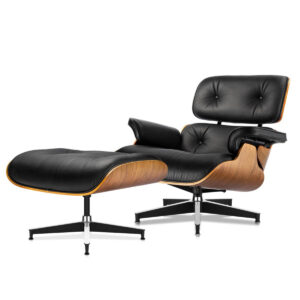 1956
1956Eames Lounge & Ottoman
Charles & Ray Eames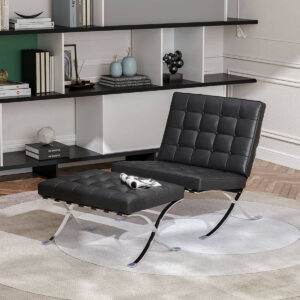 1929
1929Barcelona Chair & Ottoman
Mies van der Rohe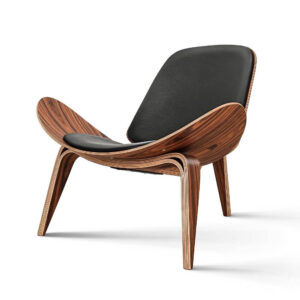 1963
1963Wegner CH07 Shell
Hans WegnerGenuine prices are current maker’s list (Herman Miller, Knoll, Carl Hansen), checked August 2026. Ours are honest replicas in leather, US stock, free shipping and 30-day returns. All three live side by side in our Designer Lounge Chairs collection.
- The moulded shell. A single curved seat-and-back shell, in plywood, fibreglass, or plastic, sitting on slim legs. Light, sculptural, often stackable. The Eames shell chairs and Wegner’s CH07 live here.
- The lounge-and-ottoman. A reclined shell or upholstered seat with a matching footstool, built for a long evening rather than a quick sit. The Eames Lounge is the definitive one.
- Scandinavian wood-forward. Exposed solid-wood frames with woven or plywood seats, warm and craft-led. Wegner’s Wishbone is the emblem.
- The organic pod. A chair you sit inside, a fibreglass shell wrapped in full upholstery. Saarinen’s Womb and Jacobsen’s Egg are the pods.
- The sling. Leather or canvas suspended in tension across a minimal frame. The Butterfly chair is the classic, casual and airy.
- Tubular or flat-bar steel. A chrome frame carrying tufted leather pads, architectural and formal. The Barcelona is the icon of this family.
Name the family you’re drawn to and the shopping gets much easier, because the icons below sort neatly into them.
The Icons, Chair by Chair
Ranked loosely by how central they are to the mid-century look, with the designer, the year, and the job each one does.
The Eames Lounge Chair and Ottoman (Charles and Ray Eames, 1956) is the centre of gravity for the whole category. Moulded plywood shells, leather cushions, a low recline, a matching ottoman. It was designed to look like a well-used first baseman’s mitt, and it remains the chair most people picture when they picture mid-century comfort. It’s the one we build, and more on that below.
The Eames moulded plywood chairs (1945 to 1946) came a decade earlier and are worth knowing by their codes: the LCW, Lounge Chair Wood, is the low plywood lounge chair people search for, and the DCW is its dining-height sibling. All curves, no upholstery, the piece that proved plywood could be art.
The Womb Chair (Eero Saarinen for Knoll, 1948) is the pod you curl up in, a fibreglass shell under soft upholstery. If what you want from a chair is to disappear into it, this is the closest cousin to the Eames Lounge in feel, in a completely different shape.
The Barcelona Chair (Ludwig Mies van der Rohe with Lilly Reich, 1929) predates the mid-century proper but anchors its formal end. A chrome X-frame carrying tufted leather cushions, built for the German Pavilion at the 1929 Barcelona Exposition. Upright and architectural, a chair you sit in rather than recline into. We build this one too.
The Egg and the Swan (Arne Jacobsen, 1958) were both designed for the SAS Royal Hotel in Copenhagen. The Egg is a tall swivelling pod that wraps around you; the Swan is its smaller, more upright partner. Pure sculpture as much as seating.
The Papa Bear Chair (Hans Wegner, 1951) is an upholstered wingback with sculpted “paw” armrests, warmer and more traditional than the plywood icons, and the most expensive chair on this list new.
Wegner’s shell chairs run from the woven-seat Wishbone (CH24, 1949) to the three-legged CH07 Shell (1963), nicknamed the “smiling chair” for the curve of its seat. Both are the Danish craft tradition at its most photogenic. The CH07 is the shell we reproduce.
The Platner Lounge Chair (Warren Platner, 1966) is almost wire sculpture, a cage of curved steel rods around a cushioned seat, catching the light like a piece of jewellery.
The Nelson Coconut Chair (George Nelson, 1955) is a wedge of shell splayed across three thin legs, as if a coconut had been cracked and one piece kept for sitting. (Nelson’s Marshmallow is a sofa, not a chair, in case the search sends you there.)
The Butterfly or BKF sling (Bonet, Kurchan, and Ferrari-Hardoy, 1938) is the honest budget icon: a leather sling hung on a folding steel frame. A genuine piece of design history and the one chair here that costs a fraction of the others, as long as you’re happy with a sling rather than a cushioned lounge.
The pattern, the Butterfly aside, is that the famous mid-century chairs are all expensive chairs. That matters for the section that follows.
The Leather Chair and Ottoman Question
More people search for a “leather chair and ottoman” than for any single designer’s name, and nearly all of them are describing the same object: the low mid-century leather lounge chair with a matching footstool. In icon terms, that’s the Eames Lounge. A Barcelona with its stool is the other honest answer, more upright and formal.
Two things decide whether one is worth buying. The first is the leather. “Genuine leather” is a real grade but a middling one; top-grain is the tier you actually want on a chair you’ll sit in daily, and a listing that just says “leather” is often hiding bonded or coated split. We wrote the full ladder in our leather chair guide if you want to be able to read a spec sheet properly. The second is the frame: real plywood and cast metal on the Eames, solid stainless on the Barcelona, not plastic dressed up as either.
A genuine Eames Lounge in leather runs around $8,700 for the chair and ottoman together, a figure we take apart piece by piece in our Eames price guide. That number is the reason the replica market exists, and the reason the rest of this guide is honest about routes rather than pretending there’s one right answer.
What “Mid-Century Møbler” Actually Means
If your searches have turned up the word møbler, it’s simply the Danish and Norwegian word for furniture (a single piece is a møbel). Collectors and vintage dealers adopted the Danish term as shorthand for the real Scandinavian article: the Wegner, Finn Juhl, Børge Mogensen, and Jacobsen lineage, built by houses like Carl Hansen and Fritz Hansen, usually in teak, often hand-joined, frequently vintage.
Searching the Danish word tends to signal that you want the genuine Danish piece rather than generic mid-century styling. We’ll be straight about the line there: we can give you the silhouette of Danish møbler, the Wegner shell for instance, as an openly-labelled replica at a fraction of vintage prices. We don’t sell vintage originals or licensed Danish production. If provenance is the point for you, a specialist dealer is your shop, not us.
Original, Replica, or Inspired: How to Actually Get the Look
There are three honest routes to a mid-century chair, and knowing which one you’re on saves a lot of money and disappointment.
Buy the genuine licensed piece. The originals are superb, made under license by Herman Miller, Knoll, Fritz Hansen, and Carl Hansen, and they hold their value. The catch is that every genuine mid-century lounge icon sits in the same bracket. A Knoll Womb is around $6,500, a genuine Barcelona around $6,500, a Fritz Hansen Egg in leather past $14,000. So swapping one icon for another to save money doesn’t work; a different icon is a different look, not a discount.
Buy a faithful replica. A replica reproduces a specific named design without the license, which is legal because the relevant patents expired decades ago. This is the only route that gets you a particular icon’s look for materially less. It’s what we do, and we’ve written honestly about exactly what you trade away versus the original, from the medallion to the resale value.
Buy an “inspired-by” high-street chair. Retailers like West Elm and Article make chairs in the mid-century idiom without reproducing any one design. West Elm’s Paulo, a bent-ply-and-leather lounge chair around $1,300 to $1,500, is the closest high-street analogue to our lane. These are legitimate and often lovely, but the word doing the work is inspired: they borrow the language and change the proportions, so if a specific icon is in your head, an homage will always land a little to the side of it.
What We Carry, and What We Don’t
Since we’ve just spent a lot of words on chairs, here’s the plain inventory. We reproduce three of the icons above, and together they make up our Designer Lounge Chairs collection:
- The Eames Lounge Chair Replica, $1,499.95, in top-grain Italian leather on an eight-ply birch shell and a die-cast aluminium base, against roughly $8,700 for the genuine pair.
- The Barcelona Chair and Ottoman, from $759.95, top-grain Italian leather on a mirror-polished 304 stainless frame, against around $6,500 for a genuine Knoll one.
- The Hans Wegner CH07 Shell Chair, $549.95, an accent chair in premium leather on moulded European plywood, the affordable Danish shape for occasional seating.
If you’re furnishing the room rather than just the chair, the Noguchi coffee table at $699.95 and the Ligne Roset Togo sofa complete the mid-century look from the same shelf. Both are pieces, not chairs, so they sit beside a lounge chair rather than replacing it.
What we don’t stock, we’ll name so you don’t waste a click: no Womb, no Egg or Swan, no Papa Bear, no Platner, no Wishbone, no plywood LCW, no Nelson Coconut, no Butterfly sling. Those are wonderful chairs and you’ll be buying them somewhere else. We’d rather tell you than pad a list with things we can’t actually sell you.
So Which Mid-Century Chair Should You Buy?
Sort yourself by what you’re really after.
If you want the mid-century look in a room and the budget is sane, a faithful replica is the honest route, and ours run from $549.95 to $1,499.95 for three of the defining icons. If you want one specific non-Eames icon, a Womb or an Egg, and provenance matters, buy the genuine licensed piece and budget five figures for it, because a replica of those isn’t something we or anyone reputable makes well.
If you’re still weighing the Eames against another icon, our guide to the lounge alternatives compares them on comfort and cost. If you want a genuine design icon on a real budget, the Butterfly sling is the one honest answer, provided you know you’re getting a sling and not a lounge chair. And if you’re furnishing a whole room, mix freely; the full furniture range lays it all out.
And if you’re weighing genuine vintage against a reproduction for the whole room rather than one chair, our vintage mid-century modern furniture guide covers that real-or-reproduction call across tables, sofas, and storage.
The look has lasted seventy years because the chairs were designed properly the first time. Whichever route you take, that longevity is what you’re paying for.
FAQ
What makes a chair mid-century modern?
Two things: the era and the design language. Mid-century modern chairs come from roughly 1945 to 1965, and they share an approach, new materials like moulded plywood, fibreglass, and bent steel used in clean, organic shapes that follow the body. A leather lounge chair with an ottoman, a plywood shell, and a chrome-framed tufted slab can all be mid-century modern despite looking nothing alike.
What is the most iconic mid-century modern chair?
The Eames Lounge Chair and Ottoman (1956) is the one most people name and picture. The Barcelona Chair (1929) and the Womb Chair (1948) are close behind for pure recognition. All three are lounge chairs, and all three are expensive as genuine licensed pieces.
What is a mid-century modern chair and ottoman?
It’s the low leather lounge chair with a matching footstool, and in most searches it means the Eames Lounge specifically. A genuine one is around $8,700 for the pair; our replica is $1,499.95 in top-grain Italian leather. The Barcelona with its stool is the other classic leather chair-and-ottoman.
Are mid-century modern replicas worth it?
For the look in a room, yes, provided the build is real: named leather grade, genuine plywood or metal, honest labelling. A good replica gets you a specific icon’s design for a fraction of the licensed price. What you give up is the medallion, the warranty, and the resale value, which we cover in full in our original versus replica guide.
What does “møbler” mean?
It’s the Danish and Norwegian word for furniture. “Mid-century møbler” is collector shorthand for authentic Danish mid-century pieces, the Wegner and Jacobsen tradition in teak and hand-joined wood, usually vintage or licensed rather than replica.
What’s the cheapest genuine mid-century icon?
The Butterfly or BKF sling chair, designed in 1938, is the one true icon that has always been affordable, because it’s a leather sling on a folding steel frame rather than a cushioned lounge. Every other icon here, genuine, sits in the mid-four to five figures.