Designer Furniture Dupes: What They Are, What’s Legal, and How to Buy a Good One
You fell for a design icon. Then you saw the price, and it had four or five figures in it.
That is the moment most people discover the world of designer furniture dupes. The terms on a listing can be confusing: they do not tell you how well a piece is built or whether its manufacture and sale are authorized. It helps to separate the product description from the rights behind the design.
So here is the plain version. What these words actually mean, whether replica furniture is legal, how to spot a good one, and how to buy the look you love without getting fooled.
Dupe, Replica, Reproduction, Counterfeit: What’s the Difference?
Four words get used as if they mean the same thing. They do not.
- A dupe (short for duplicate) is anything that closely mimics the look or feel of a pricier piece at a lower price. It is a casual word, more social media than trademark law.
- A replica or reproduction recreates a particular design. The term alone does not establish whether it is licensed or lawful to sell.
- An exact replica goes further, matching the original’s scale, proportions, materials, and construction as closely as possible.
- A counterfeit involves a spurious mark that is identical to, or substantially indistinguishable from, a registered trademark. A protected mark can cover a product configuration as well as a name or logo.
Clear labeling matters, but it does not settle the legal question. A product described as a replica can still infringe rights in its name, appearance, or other protected elements.
Treat “dupe,” “replica,” and “inspired by” as descriptions to investigate, not assurances of legal clearance.
Is Replica Furniture Legal?
There is no blanket answer for replica furniture in the United States. It depends on the particular product, the rights that apply to it, and how it is marketed.
An expired design patent ends protection under that patent. It does not automatically clear the product for copying or sale. Trademark law can separately protect names and logos, and qualifying nonfunctional aspects of a product’s appearance may be protected as trade dress when they identify its source.
Copyright is a separate question. Furniture is a useful article, but separable artistic elements may qualify for copyright protection. Photographs and written copy can also have their own rights. Permission to use a supplier’s photograph does not establish permission to reproduce the furniture it depicts.
Calling a piece a replica, omitting a logo, or using “inspired by” does not by itself make its sale lawful. For background, see the USPTO’s guidance on product-design trade dress and the US Copyright Office’s explanation of useful articles. This is general information, not a legal assessment of any product in this guide.
The Quality Gap Is Real: How to Spot a Good Replica
The people who look down on replicas are not entirely wrong.
Plenty of replicas are junk. They get reverse-engineered from a photo, come out subtly off-scale, and hide cheap foam under a thin cover that sags in a season. If you have ever sat on a “designer” dupe that felt like a pool float, you have met one.
But the real divide is not replica versus authentic. It is good materials versus cheap. A replica built with genuine materials, solid hardwood or steel, high-density foam, real leather or a proper named fabric, can last 10 to 15 years of everyday use. The bonded-leather-and-MDF kind is what earned dupes their disposable reputation.
Here is how to tell which one you are looking at, before you spend a penny:
- The seller calls it a reproduction, not “authentic.” Honesty about what it is comes first.
- The materials are named. A solid wood or steel frame, high-density foam, real leather or a specified fabric, not a vague promise of “premium materials.”
- The dimensions are published and match the original. Scaled-down copies lose the whole look.
- You get the specs when you ask. A confident maker hands them over. Evasive answers are the clearest red flag there is.
- Returns and a warranty stand behind it. A seller who believes in the build says so in writing.
A good replica passes every one of these without flinching. A knockoff starts getting vague around question two.
The Honest Trade-offs a Replica Can’t Beat
A replica is a fine way to get the look. It is not a way to make money, and we would rather tell you that up front.
An authentic piece from a licensed maker like Herman Miller, Knoll, or Vitra is an asset. Kept well, it can hold 70 to 90 percent of its value, and rare pieces appreciate. It comes with provenance, a genuine lineage back to the designer, and often decades of official repair parts. A replica has none of that. It carries essentially no resale value, no certificate, and no manufacturer to call in twenty years.
So the honest advice is simple. If you are buying an heirloom, an investment, or a collector’s piece, buy the authentic original and enjoy every bit of it.
If you want the look, the shape, and real everyday comfort in your home now, without remortgaging for it, a good replica is the right call. There is nothing second-best about that. You are choosing the piece you can actually live on over the label you would only frame, and doing it with clear eyes. Plenty of design lovers own both: one authentic piece they saved years for, and honest replicas filling out the rest of the room.
Designs Commonly Reproduced
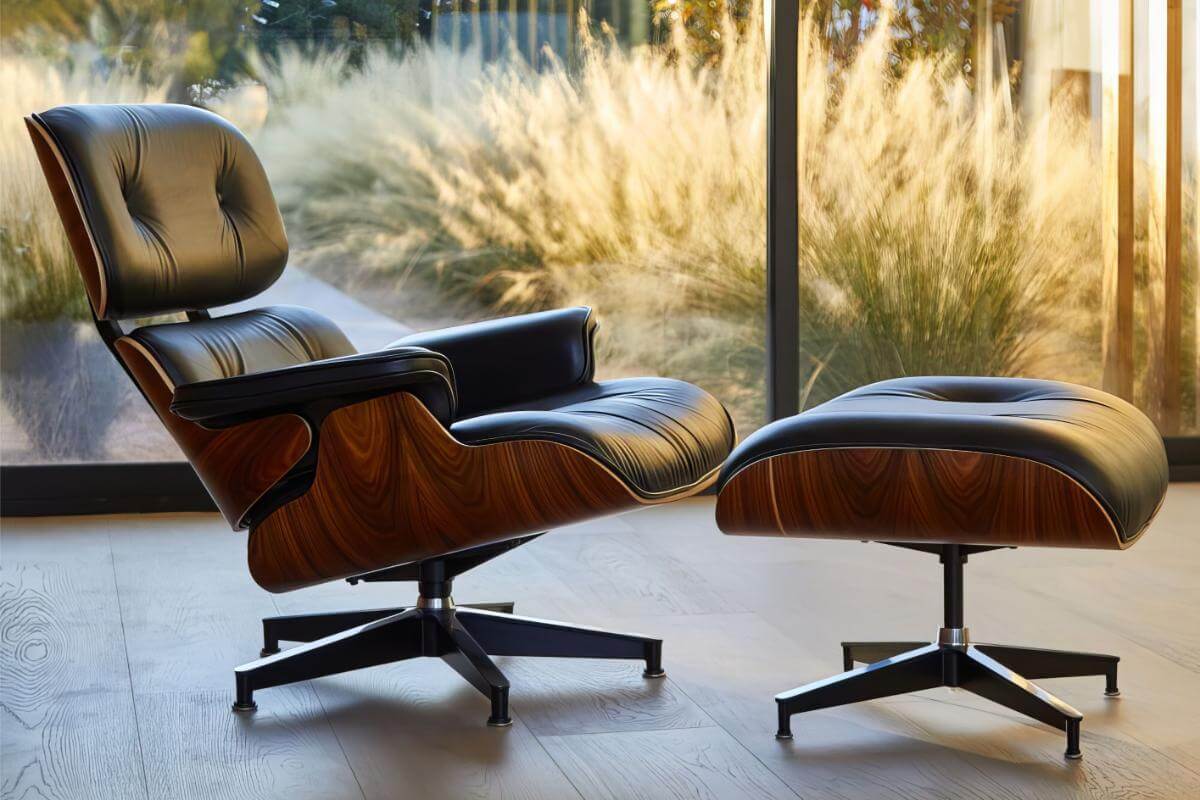
Some designs get reproduced more than others, for the simple reason that people cannot stop wanting them.
- The Eames Lounge Chair, the leather-and-plywood classic that anchors a whole room.
- The Togo, Michel Ducaroy’s low, quilted, frameless sofa, designed in France in 1973 and still one of the most copied shapes in the world.
- The Noguchi Coffee Table, an iconic coffee table by Isamu Noguchi.
- The USM Haller system, the modular metal-and-ball storage grid that has been reconfigured into shelving, sideboards, and credenzas since the 1960s.
- The Butterfly and Ball chairs, where the gap is stark. An authentic Ball chair runs at least $7,500, while a good reproduction starts around $1,000.
Our catalogue includes reproductions of the Eames Lounge Chair, Togo, Noguchi Coffee Table, and USM Haller system. They are described as reproductions rather than authentic originals. That description is not a statement that the products have received legal clearance.
How to Buy a Dupe You Won’t Regret
Check the seller’s specifications, returns, and warranty before buying. Those checks help you assess the purchase, but they do not replace a separate assessment of the rights in the design.
A seller worth your money is transparent. They call the piece a reproduction, publish the real materials and true dimensions, never fake a designer’s label, and stand behind the build with returns and a warranty. Everything you need to judge is out in the open, not buried or dressed up.
That is exactly how we sell. Daedalus makes design-inspired reproductions of icons like the Togo, the Camaleonda, the Soriana, and the Cloud, honest about what each one is, built in real materials, and delivered in days rather than the months a made-to-order original can take. You can see the whole lineup in the sofa collection.
We will always tell you a piece is a reproduction. The iconic look should not cost a fortune, and the truth should not cost you anything.
FAQ
Is replica furniture legal?
It depends on the product and the rights that apply. An expired design patent does not settle separate trademark, product-shape trade-dress, or copyright questions. Labels such as “replica” and “inspired by” do not establish permission to manufacture or sell a copy. This is general US information, not product-specific legal advice.
What is the difference between a replica and a counterfeit?
“Replica” describes a reproduction; it does not establish its legal status. Counterfeiting concerns the use of a spurious mark identical to, or substantially indistinguishable from, a registered trademark. Other forms of infringement can arise even when a product has no copied logo and is openly labeled a replica.
Are designer furniture replicas worth it?
For most people who want the look and everyday comfort rather than a resale asset, yes. The deciding factor is materials and honesty, not the replica label. Genuine foam, a solid frame, and a real cover can last 10 to 15 years, while cheap MDF-and-bonded-leather knockoffs do not.
How can you tell a good replica from a cheap knockoff?
Look for genuine materials (solid hardwood or steel, high-density foam, real leather or a named fabric), true-to-original dimensions, and a seller who publishes exact specifications on request. Evasive answers about what something is made of, or how big it really is, are the clearest warning sign.