Pierre Paulin: The Designer Behind the Dune (and Half the Chairs You’ve Sat In)
You have almost certainly sat in a Pierre Paulin design, or scrolled past one in a music video, without ever knowing his name. The low, curved Dune sofa that keeps turning up in celebrity living rooms is his. So are some of the most recognisable chairs of the last century, the ones shaped like a ribbon, a tongue, and a slice of orange.
Paulin was a French designer who treated a chair like a sculpture you could sink into, and who was trusted to furnish a president’s private apartments. Here is who he was, what he made, and why his work is suddenly everywhere again.
Who Was Pierre Paulin?
The man who reinvented the modern chair started out wanting to carve stone.
Paulin was born in Paris in 1927, a nephew of Georges Paulin, the car designer who invented the Eclipse retractable hardtop roof. Design, in other words, was in the blood. His own path started sideways, though. He failed his baccalauréat, trained as a ceramist in Vallauris on the French Riviera and as a stone-carver in Burgundy, and set his heart on becoming a sculptor. Then an injury to his right arm ended that plan for good.
The pivot changed design history. He enrolled at the École Camondo in Paris and joined the studio of Marcel Gascoin, where he absorbed the clean, humane lines of Scandinavian design. He showed early work at the Salon des Arts Ménagers in 1953, and by 1954 he was designing for Thonet, already experimenting with the stretchy new materials that would define everything he did next.
The sculptor’s eye never left him. He simply aimed it at furniture instead of stone, and started treating a chair as a single continuous form rather than a box with legs.
The Chairs That Made Him Famous
His breakthrough idea came from a swimwear show.
Watching fabric stretch to fit the body, Paulin saw a way to build a chair. Instead of upholstering over a bulky wooden frame, he wrapped a slim steel frame in foam, then pulled a single piece of stretch jersey over the whole thing like a second skin. The result had no visible seams and no bad angle. It looked just as good from behind as from the front. Comfort was not an afterthought bolted on at the end. It was the starting point.
Working with the Dutch manufacturer Artifort through the 1960s, he turned that idea into a series of icons you have almost certainly seen:
- The Mushroom chair (1960), a low, rounded cocoon you fold down into.
- The Ribbon chair (1966), a looping band of colour caught mid-twist.
- The Tongue chair (1967), a single sinuous curve made for lounging low to the floor.
- The Orange Slice, the Oyster, and the later Pacha, each one soft, bright, and unmistakably his.
Where most furniture of the era still stood on stiff legs, Paulin’s seating melted toward the floor in bold, poppy colour. Design writers later called him a sculptor of spaces, and the label fits. These were functional sculptures that happened to cradle a body, and they still anchor design-forward rooms sixty years on.
The Dune: His Great Unbuilt Idea
Paulin’s most talked-about sofa today is one he never got to sell.
In 1968 he designed the Dune Ensemble, a modular seating landscape rather than a single couch. Inspired by Herman Miller’s Action Office, the idea was radical for its time: a set of low, soft foam forms you arrange however you like, so you become the architect of your own space. No fixed front or back, no formal arrangement, just a terrain of seating you shape around the room.
It was too far ahead of its moment to survive. Paulin prototyped the Dune with Herman Miller around 1970, but the company shelved it during the oil crisis, because a piece built almost entirely of sculpted foam and fabric was too expensive to make at scale. The design then sat unrealised for more than four decades.
It only became real in 2014, when Paulin’s son Benjamin put it into production through the family firm, Paulin Paulin Paulin. He called it “the first late edition of the dream that never came true.”
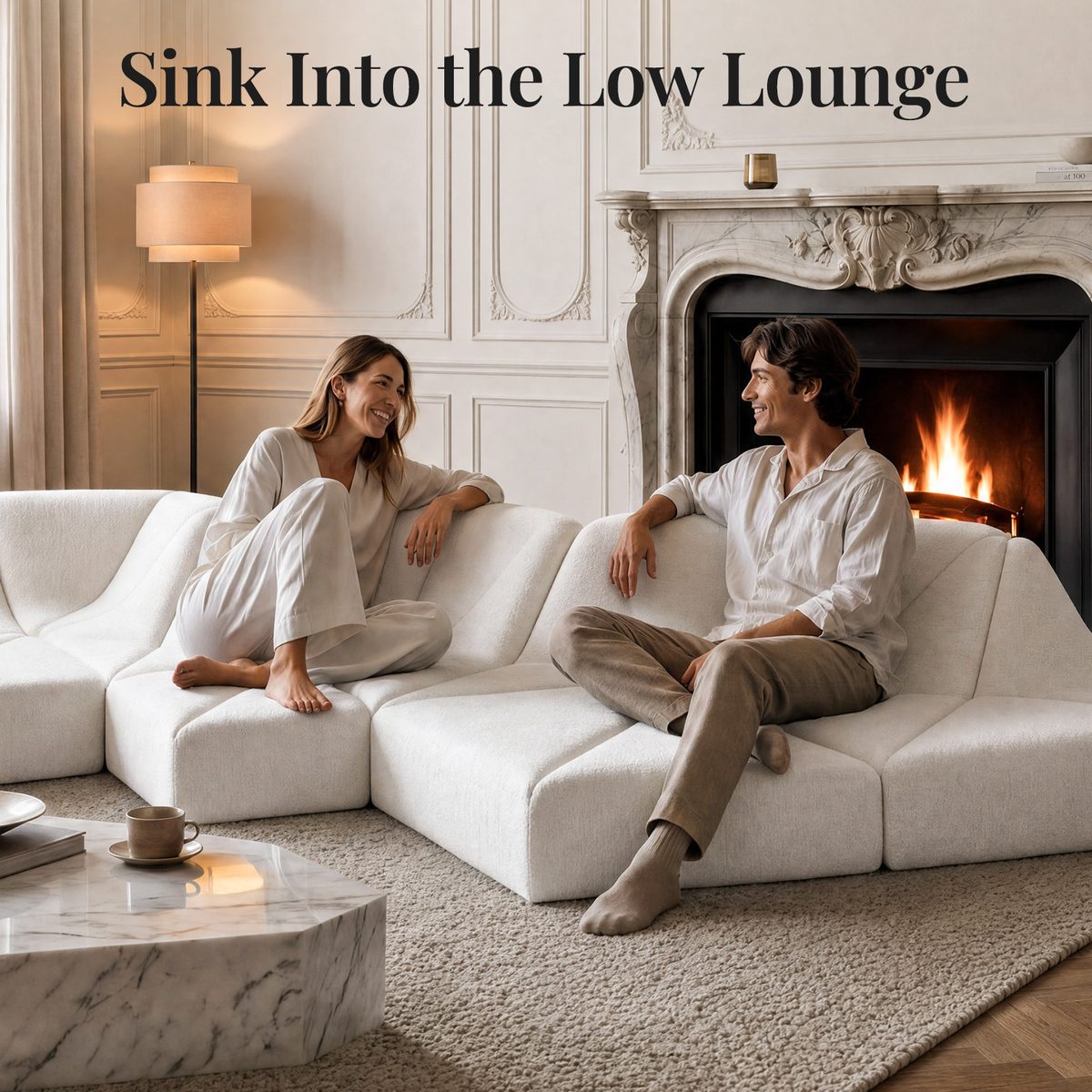
The shape is unmistakable: a low, curved, continuous landscape with a seat just 13 to 15 inches off the floor, well below a standard sofa. Authenticated vintage pieces now sell for $18,000 to $32,000 and up. Not bad for an idea nobody would build in 1970.
Furnishing the Élysée Palace
France trusted Pierre Paulin with the president’s private rooms.
In 1971 the Mobilier National invited him to furnish Georges Pompidou’s private apartments inside the Élysée Palace, and Paulin dropped the formality entirely. He redesigned Napoleon III’s former bedroom using materials borrowed from the space age, cast aluminium and plastic coating linked to the Apollo spacecraft, under a chandelier of roughly 9,000 glass stems and balls set against a mirrored ceiling. It remains the only room in the palace that still wears its 1970s design. He was invited back in 1983 to furnish the office of President François Mitterrand.
One thing worth clearing up, because plenty of sources get it wrong: the Élysée commission and the Dune are two different projects. You will read that the Dune was “designed for the Élysée Palace.” It was not. The palace work was its own thing, and the Dune was a separate, earlier idea. If a listing tells you otherwise, it is repeating a myth.
Beyond Furniture: a Designer of Almost Everything
Chairs were only part of the story.
Paulin founded a design agency, ADSA, with his wife Maïa Wodzislawska and Marc Lebailly, then co-created ADSA & Partners with Roger Tallon in 1981. Through it he designed far beyond the living room: cookware for Tefal, and products for Calor, Ericsson, Renault, Saviem, Thomson, and even Airbus. He shaped public spaces too, from the TGV terminal at Gare de Lyon to the Louvre’s Denon wing. He retired to the Cévennes in 1994 and kept designing anyway.
One myth to retire while we are here. The futuristic Djinn chairs in Kubrick’s 2001: A Space Odyssey are constantly credited to Paulin. They were actually designed by Olivier Mourgue. Paulin’s real fingerprints show up elsewhere, in the work of later designers from Verner Panton to Zaha Hadid.
Why Pierre Paulin Is Everywhere Again
Half a century on, Paulin is having a bigger moment than he had in his own lifetime.
A 2016 retrospective at the Centre Pompidou in Paris put him back in front of a new audience, and pop culture did the rest. Frank Ocean owns a vintage Dune prototype and posted it online.
The Kardashian-Jenners, Beyoncé, and Jay-Z have all been seen with his pieces. Even the “Gucci Dune” that racked up millions of views online points to the same pull, though it is worth knowing it is an independent art piece by creator Trevor Gorji, not an official Gucci product.
As Benjamin Paulin puts it, there is “an immediate connection between the youth of my father when he designed those pieces and the youth of the people who are attracted to them now.”
There is a catch, of course. Authentic Paulin production and genuine vintage run well into the tens of thousands.
So if what you love is the shape, that low, curved, modular Dune, a design-inspired reproduction is the honest and affordable way in.
Our own Dune Modular Sofa captures that look in blue or white chenille, and if you want to see how it compares to the branded versions, we broke it all down in our full Dune comparison. It is a reproduction, never an authentic Paulin, and we will always tell you so. What it does is put his idea within reach.
FAQ
What is Pierre Paulin best known for?
Pierre Paulin is best known for his sculptural 1960s seating for the Dutch brand Artifort, especially the Mushroom, Ribbon, and Tongue chairs, built from steel frames wrapped in foam and stretch fabric. He is also known for furnishing the Élysée Palace for two French presidents and for the modular Dune sofa.
Did Pierre Paulin design the Dune sofa?
Yes. Paulin designed the Dune Ensemble in 1968 as a modular seating landscape. It was prototyped with Herman Miller around 1970 but shelved during the oil crisis, and only went into production in 2014 through his family’s firm, Paulin Paulin Paulin.
Is the Pierre Paulin Dune sofa still made?
Yes. The authentic Dune is produced today by Paulin Paulin Paulin, made to order at collector prices, while genuine vintage pieces sell for tens of thousands at auction. Because of that, many people who love the shape choose an affordable design-inspired replica of it instead.
Did Pierre Paulin design the chairs in 2001: A Space Odyssey?
No. The Djinn chairs in Stanley Kubrick’s film are often credited to Paulin, but they were designed by Olivier Mourgue. Paulin’s influence shows up elsewhere, in the work of later designers such as Verner Panton and Zaha Hadid.