Original Barcelona Chairs vs. Replicas: An Honest Comparison
Search for original barcelona chairs and the results split hard: an authentic Knoll piece priced like a used car, sitting right next to dozens of lookalikes under $800. That gap is not a typo. It is two different products wearing the same silhouette, built for two very different reasons.
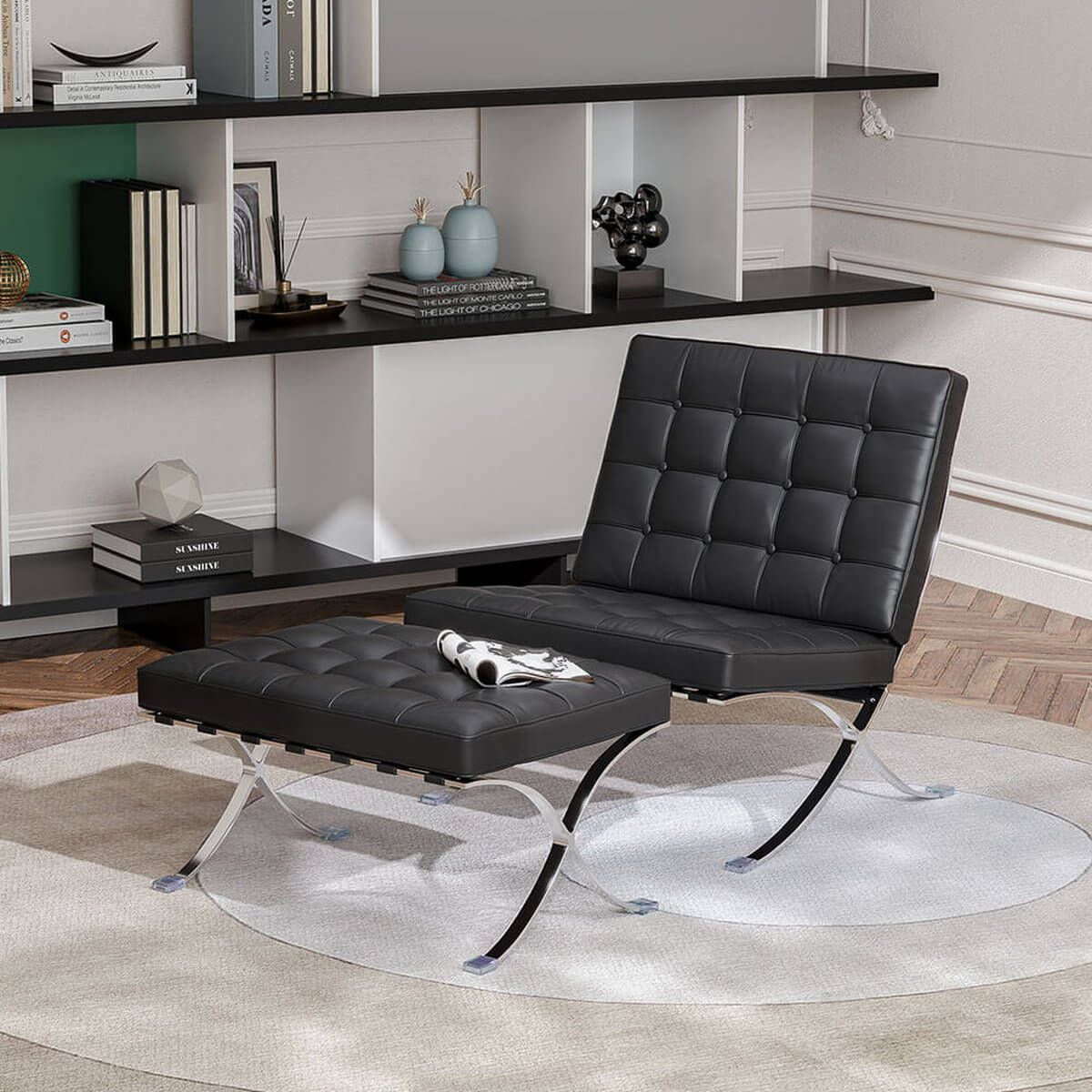
Most people land here confused about what the extra thousands actually buy. A name, better leather, or a stamp pressed into a steel leg? The honest answer is a mix of all three, plus a piece of design history most retailers never bother explaining at all.
We sell a design-inspired Barcelona replica, and we will not pretend it is a Knoll. This guide breaks down exactly where the authentic chair earns its price, where an honest replica holds up, and where it does not, so you know what you are actually paying for either way, whichever one you choose and whatever your budget looks like.
What “Original” Really Means: The Knoll Barcelona Chair
Only one company is legally allowed to make an original Barcelona chair, and most shoppers never learn its name: Knoll, now part of MillerKnoll, which holds the registered Barcelona® trademark and license. Other manufacturers can build a similar-looking chair, but none of them can legally call it a Knoll or an original.
The design itself dates to 1929, created by Ludwig Mies van der Rohe for the German Pavilion at the Barcelona International Exposition. It was built as a ceremonial seat for the King and Queen of Spain, though the pavilion itself stood only seven months before it helped define modern architecture.
What most retellings leave out, including Knoll’s own product pages, is Lilly Reich. She co-designed the chair and shaped the interiors of the pavilion alongside Mies, and design historians have spent decades restoring credit that was quietly dropped for most of the 20th century.
Knoll’s manufacturing rights came together in stages rather than on one clean date, with sources placing the formal license anywhere from the 1940s through the 1960s. The chair was not even officially named the “Barcelona chair” until 1987, decades after Mies and Reich first showed it in Spain.
What has not changed is how actively Knoll protects that name today. Other replica sellers routinely disclaim that they are not affiliated with or endorsed by MillerKnoll, a sign of an active, enforced trademark rather than an abandoned one. The original chair still sells today through knoll.com, priced on the strength of that licensed provenance. That price is where the real comparison starts.
1. The Price Gap: What the Original Costs vs. a Replica
Barcelona chair prices cover an enormous spread, from five figures down to a few hundred dollars, and knowing what sits behind each number is how you buy well.
The number that actually decides most buying decisions: an original Knoll Barcelona chair in leather runs roughly $6,900 to over $9,500 depending on frame finish and material, with list pricing reaching close to $12,725 before Knoll’s typical 25 percent site discount. The fabric version runs lower, roughly $4,600 to $5,400. The matching Barcelona Stool, the ottoman, adds about $2,295.
Pair a leather chair with its ottoman and you are looking at roughly $9,000 to $12,000 or more, sourced directly from knoll.com. Design Within Reach, Knoll’s own retail arm, lists the same fabric pricing independently, which confirms this is a genuine current price rather than a one-off promotional quirk.
Our design-inspired Barcelona chair and ottoman replica is $759.95 for the chair alone, or $869.95 for the chair and ottoman together.
That is not a hidden markup on the original’s side. You are paying for the licensed name, the trademark, the hand construction, and decades of collector value that only Knoll can legally attach to this design. A meaningful share of that gap sits in details like the frame’s hand-buffing and the individual production number etched into every genuine chair.
None of that is manufactured scarcity. It is genuinely what licensed provenance costs, and it moves with Knoll’s own promotional calendar rather than staying fixed.
The verdict: if the Knoll name and everything it carries matters to you, the price is the price, and it is worth checking knoll.com directly since it shifts with their sales. If what you want is the 1929 silhouette in honest materials, the savings are real, and it is thousands of dollars, not a rounding error.
2. Construction: Where the Real Differences Live
The gap between a $9,000 chair and an $800 one is not always where you would guess.
Knoll’s authentic frame is a seamless X-cross in polished chrome or 304 stainless steel, hand-buffed until no weld marks show at the join. The cushions are built from 40 individual leather panels, cut from a single hide, hand-welted and hand-tufted with buttons roughly the size of a dime. Knoll sources that leather from Spinneybeck, and the cushions attach to the frame with color-matched belting leather straps, with the strap edges dyed to match the upholstery as a final hand-finishing step.
Our replica uses solid 304 stainless steel, the same alloy family Knoll uses on its stainless frame option, paired with top-grain Italian leather. That is where the honesty matters most: we are not going to tell you our cushions are cut and hand-welted across 40 panels from a single hide the way Knoll’s are, because we have not verified that claim and will not make it just to sound impressive.
What a good replica reproduces is the original Barcelona chair’s form, plus materials built to carry daily wear, the look, and years of use. What it does not carry is the licensed provenance, the Spinneybeck sourcing, or the exact hand-welding pedigree that comes stamped into a Knoll frame.
Best for: buyers who want the 1929 form in materials built to last, without paying for pedigree. Skip if: the hand-welded construction pedigree itself is the point of the purchase, not just the look.
3. Honest Replica vs. Cheap Knockoff: How Not to Get Burned
Choosing a replica over the original Barcelona chair is not the risky part. Choosing a bad replica over an honest one is where people actually lose money.
Four places to check on any seller, not just us:
- Frame material. Solid 304 stainless steel resists corrosion and will not flake if it gets scratched. Chrome-plated mild or tubular steel, by contrast, bubbles and pits at the joints over time and rusts once the plating wears through.
- Leather. Top-grain leather softens and holds up for years. Bonded leather, PU, or PVC creases sharply and starts delaminating within a couple of years.
- Cushion construction. Look for properly cut, structured panels with real welting. A bad knockoff uses a few large panels with flat machine stitching, or fake piping glued on to fake the tufted look.
- Straps and hardware. Genuine leather belting with real snaps holds cushions in place for years. Elastic or fabric straps sag within months, often paired with plastic buttons instead of leather-wrapped ones.
- Foam and fill. High-resilient, multi-density foam wrapped in fiberfill holds its shape for years. Cheap, low-density foam bottoms out and flattens within a year or two of regular use, no matter how good the leather on top looks.
Our chair uses solid 304 stainless steel and top-grain Italian leather, backed by a 5-year warranty and free shipping across the US in 4 to 7 days. Those are the signals of a seller with nothing to hide, whether you buy from us or not.
Direct recommendation: run any Barcelona replica you are considering through this checklist before you buy, not after it arrives.
4. How to Spot a Fake (and a Real Knoll)
If a listing claims to be an original Knoll Barcelona chair, five checks settle it fast.
- The stamp. Look for the KnollStudio stamp and Mies van der Rohe signature on the frame, on the back right leg for chrome models or the underside for stainless. Knoll only started adding this stamp in 1996, so its absence does not prove a fake on an older piece, but fake stamps often show off spacing or a sticker standing in for a real etched mark.
- The production number. Genuine chairs carry an individual number etched alongside that stamp.
- The frame join. Run a hand along the X-cross: a genuine chair shows no visible weld marks at the join.
- The cushion. Check for 40 hand-welted leather panels with no seams on the front or top corners. Fakes tend to use one large piece of hide with piping added afterward.
- The weight. Pick it up. A genuine chair is heavy, and one that feels unusually light signals a thin or hollow frame.
The verdict: our chair will never carry the KnollStudio stamp, because it is not a Knoll and we are not going to pretend otherwise. If that stamp and its provenance are what you are after, buy the authentic. If the 1929 design in honest materials is what you want, that is us.
The Bottom Line: Which Barcelona Chair Should You Buy?
The original Knoll buys you licensed provenance, Spinneybeck leather, a hand-welted pedigree, and collector value, along with an invoice that runs into five figures for a chair and ottoman. An honest replica buys you the same iconic 1929 form, in solid 304 stainless steel and top-grain leather, for under $900.
Neither choice is wrong. What is wrong is buying either one without understanding what the price actually reflects, or landing on a knockoff that fails the checklist above and delivers neither the pedigree nor the durability.
If licensed provenance, resale value, or owning the genuine article matters to you and the budget allows it, buy the Knoll and use the five authentication checks above before you do. If what you actually want is Mies van der Rohe and Lilly Reich’s design in your living room, built from materials that hold up and backed by a warranty and real US shipping times, the replica is the rational buy.
Ready to see it in person? Browse the Barcelona chair and ottoman replica directly, or explore the full designer lounge chair collection if you are still comparing icons.
FAQ
How much does an authentic Knoll Barcelona Chair cost?
An original Knoll Barcelona chair runs roughly $4,600 to $5,400 in fabric and $6,900 to over $9,500 in leather, based on current knoll.com pricing, with list prices reaching close to $12,725 before Knoll’s standard discount. The matching ottoman adds about $2,295. Pricing shifts with Knoll’s ongoing promotions, so treat these as a range rather than a fixed figure.
Why are Barcelona chairs so expensive?
An authentic Barcelona chair is expensive because you are paying for Knoll’s license, hand construction across 40 leather panels, Spinneybeck leather, and decades of collector value, not just a place to sit. Those are the real cost drivers behind most expensive designer chairs. A design-inspired replica built in the same core materials, solid stainless steel and top-grain leather, without the licensing, is what brings the price under $900.
Who designed the Barcelona Chair?
Ludwig Mies van der Rohe designed the Barcelona chair in 1929 for the German Pavilion at the Barcelona International Exposition. Lilly Reich co-designed the chair and the pavilion’s interiors alongside him, a contribution that was historically left uncredited and has only recently been more widely acknowledged by design historians. For the Pavilion collaboration and why some labels credit only Mies, read our Barcelona Chair design history
How can I tell if a Barcelona Chair is real or fake?
Check for the KnollStudio stamp and Mies signature (only present on chairs made from 1996 onward), a seamless welded frame with no visible joins, 40 hand-welted leather panels from a single hide, genuine leather belting straps, and overall heft, since a genuine chair is notably heavy. See the spot-a-fake section above for the full walkthrough.
Is it legal to buy a Barcelona Chair replica?
Generally, yes. Reproduction furniture that does not use the Knoll or Barcelona® trademark, and does not falsely claim to be a genuine Knoll, is commonly sold legally in the US. The legal risk sits in false advertising, claiming a replica is authentic, not in producing a similar design once the original protections have run their course. This is general information, not legal advice.
Is the Daedalus Barcelona chair a real Knoll?
No. It is a design-inspired replica built from solid 304 stainless steel and top-grain Italian leather, and it is not affiliated with or endorsed by Knoll or MillerKnoll. We say that plainly because pretending otherwise is exactly what we are not willing to do.